Antique Insect Jewelry - Beauty in the Grotesque?
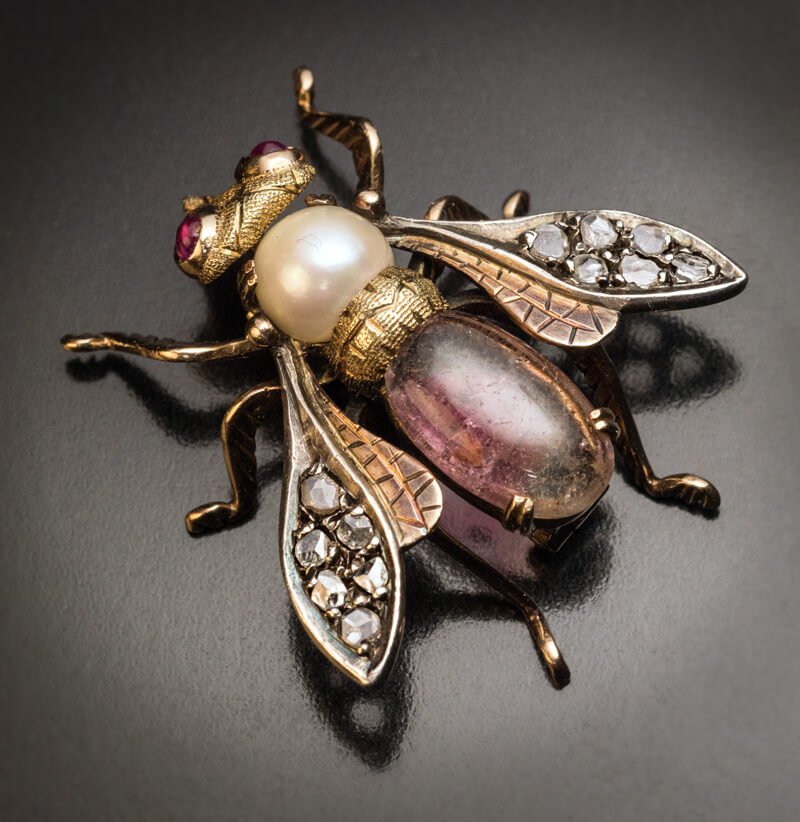
Antique insect jewelry has an enduring appeal. Those of us who have an interest in beautiful historic artefacts, and particularly in adornments from times gone by, often share a fascination with the macabre. Insects, although often incredibly beautiful, are also regarded as pests. These creatures are associated with both decay and renewal. They can be colourful and delicate but they can also be the very opposite, making us squirm and shiver. So why do we, as humans, have a long history of creating jewelry depicting these creatures? The answer lies in a long and fascinating relationship between human adornment, symbolism and the natural world.
Early Examples of Insect Jewelry
• Scarabs that Symbolised the Heavens
To understand the origins of antique insect jewelry, we need to look to North Africa, where the ancient Egyptians revered the humble scarab beetle and began creating jewels in its image.
The scarab (also known, rather less romantically, as the dung beetle) would roll piles of the aforementioned material into neat little balls. The Egyptians saw this movement as a reflection of the Earth’s journey around the sun and considered it worthy of crafting out of precious materials. The stunning jewelry created in this period, from materials like high-carat gold, lapis, carnelian and a ceramic material called faience, was incredibly detailed and often worn as talismans.
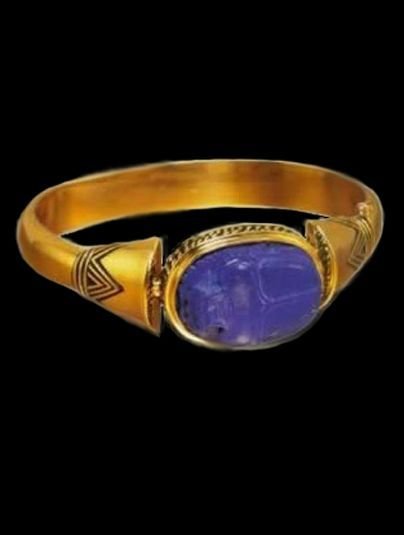
An early Ancient Egyptian high carat gold bracelet with a carved scarab in lapis lazuli.
Antique Insect jewelry From Around the World
• From the Mayans to Japanese Master Craftsmen
While this may represent one of the earliest examples, it certainly wasn’t where the depiction of insects in jewelry ended. Across the world, insects were rendered in precious materials and worn as adornments, not least among the Mayan civilisation in the Americas, where genuine insects were embellished with gemstones and worn as jewelry.
In the Far East, master craftsmen were also creating stunning pieces decorated with carefully inlaid moths, beetles and even caterpillars. This technique, whereby tiny pieces of shell, mother-of-pearl, amber and resin were hand-carved and set into ivory, bone and metal, was known as the ‘Shibayama’ technique.
Although insects were used as symbols in decorative arts and jewelry around the world for many years, it was the Victorians who made insect jewelry commercial and popular in the West — to the point where even royalty would happily wear insect jewelry.
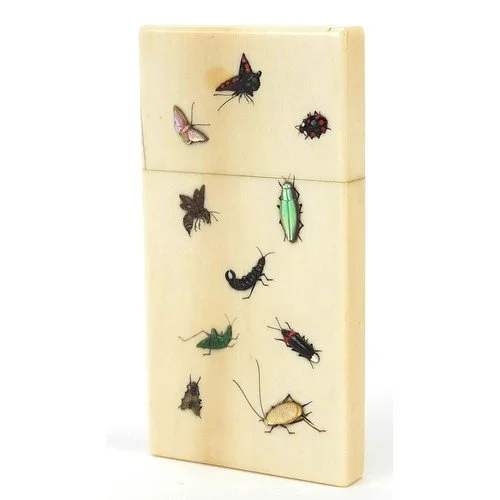
Authentic Japanese Shibayama work
Victorian-era Antique Insect Jewelry
• An Era-Defining Obsession with Natural History
The Victorians were obsessed with natural history. From around the 1860s onwards, anyone with their eye on the fashions of the era took inspiration from the natural world. Wherever they could include natural materials, symbols of flora and fauna or gestures towards the animal world, they built it into their looks.
Insects offered endless inspiration for those making fine jewelry. Their natural iridescence, delicate features and colours were all celebrated. Insect brooches, gemstone spider pendants, rings with scarabs, insect fobs and carved agate fly earrings all became popular among the fashionable set in Victorian England and across Europe. There was even a resurgence in the Japanese Shibayama technique, now mastered by the Victorian-era silversmiths of London and Birmingham.
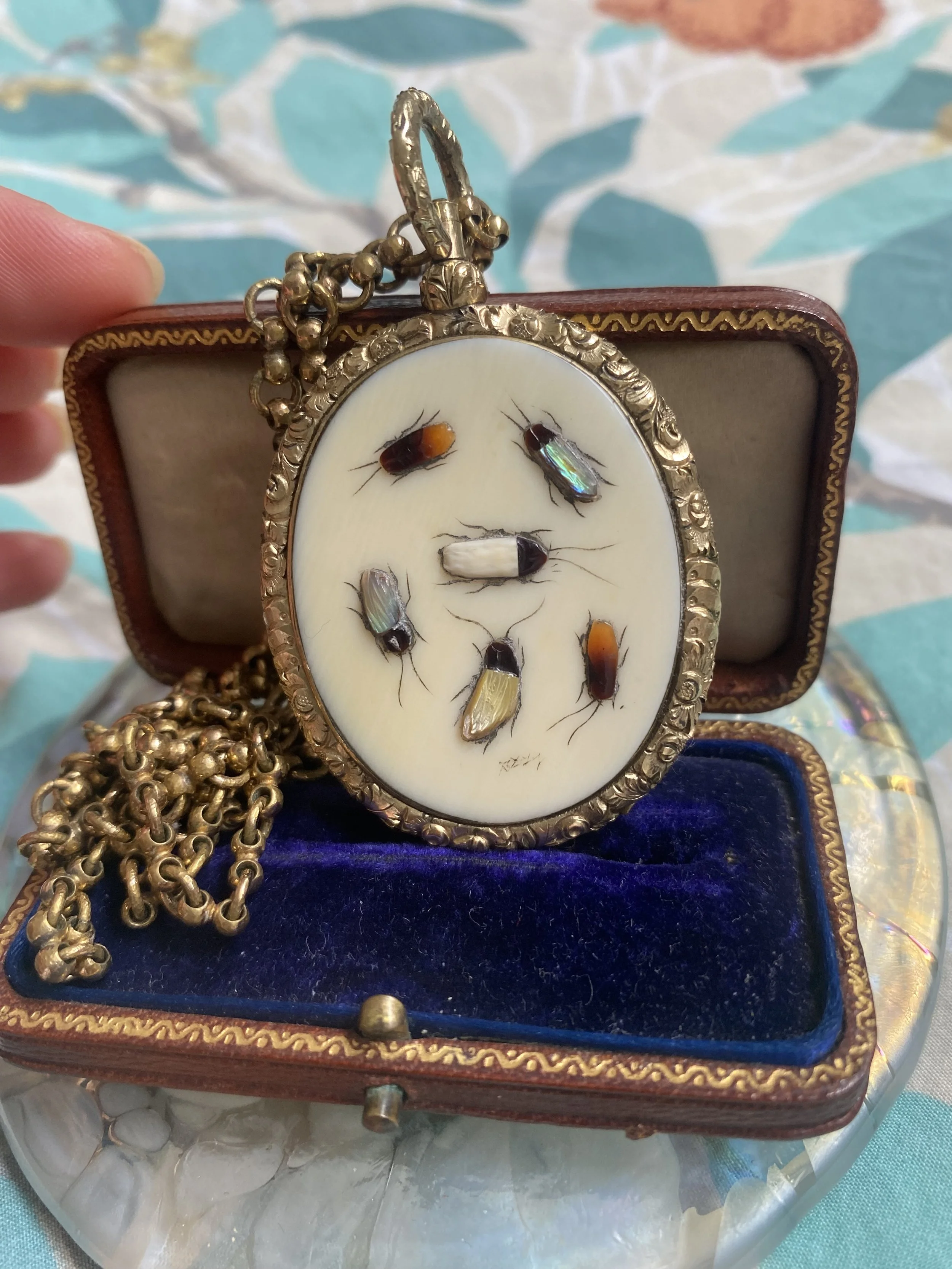
An example of Shibayama work probably carried out in England. The same technique is still being used today to add delicate insects to wearable vintage pieces.
Antique Insect Jewelry in Today’s Market
• The Weirder the Better?
Here at The Windsor Archive, we’re noticing a very active interest in antique insect jewelry among younger buyers and collectors. The coming together of the beautiful and the grotesque is appealing to those who like their antique jewelry to start conversations. Wearing a fine pendant depicting a fly, or earrings adorned with beetles, is an unexpected choice and still capable of raising eyebrows even today. Particularly prized are pieces where the insects are rendered with remarkable realism — such as Shibayama jewelry — or where genuine insects, such as scarabs, are set into metal and carefully conserved for longevity.
It is rather wonderful to celebrate natural history through jewelry. The Victorians showed us that there is beauty even in unlikely places, and it is for us, as collectors and enthusiasts, to keep that message alive.